



dbx Analog Loudspeaker Crossover





All three crossovers use the same filter design, a state-variable Linkwitz-Riley alignment at 24 dB per octave, which is the standard that keeps the summed response flat and the drivers in phase through the crossover region. Frequencies are set on the front panel from 45 to 960 Hz, or 450 Hz to 9.6 kHz with the x10 switch engaged, one switch per channel.
The 223xs is the two-way stereo box that becomes a three-way in mono mode. The 234s and 234xs are three-way stereo, four-way in mono, differing only in connector: 1/4-inch TRS on the 234s, XLR on the 234xs and the 223xs. Every model adds a 40 Hz Butterworth 12 dB per octave high-pass per channel to keep subsonic energy out of the drivers, a phase invert switch on each output, and an LF sum for feeding a single subwoofer from a stereo pair. Dynamic range is better than 106 dB unweighted on any output.
| Type | Analog loudspeaker management crossover |
|---|---|
| Configuration | 223xs stereo 2-way or mono 3-way / 234s and 234xs stereo 3-way or mono 4-way |
| Connectors | 223xs and 234xs XLR / 234s 1/4" TRS |
| Crossover Filter | Linkwitz-Riley, 24 dB/octave, state-variable |
| Crossover Frequencies | 45 to 960 Hz, or 450 Hz to 9.6 kHz with x10 switch |
| Low Cut Filter | 40 Hz Butterworth, 12 dB/octave, one per channel |
| Bandwidth | 20 Hz to 20 kHz, +/-0.5 dB |
| Dynamic Range | >106 dB unweighted, any output |
| Max Input / Output | >+22 dBu in, >+21 dBu out into 2k ohms or greater |
| Per-Output Controls | Phase invert switch; LF sum switch |
Related
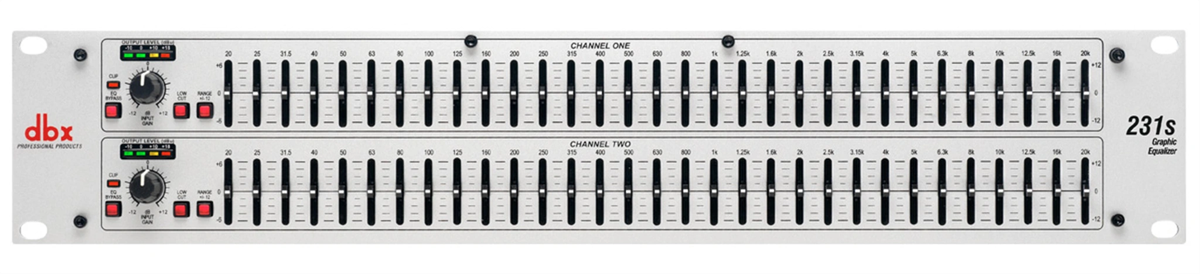 dbx 231s Dual 31-Band Constant Q Graphic Equalizer
View product ›
dbx 231s Dual 31-Band Constant Q Graphic Equalizer
View product ›
 dbx 266xs Dual Compressor / Gate
View product ›
dbx 266xs Dual Compressor / Gate
View product ›
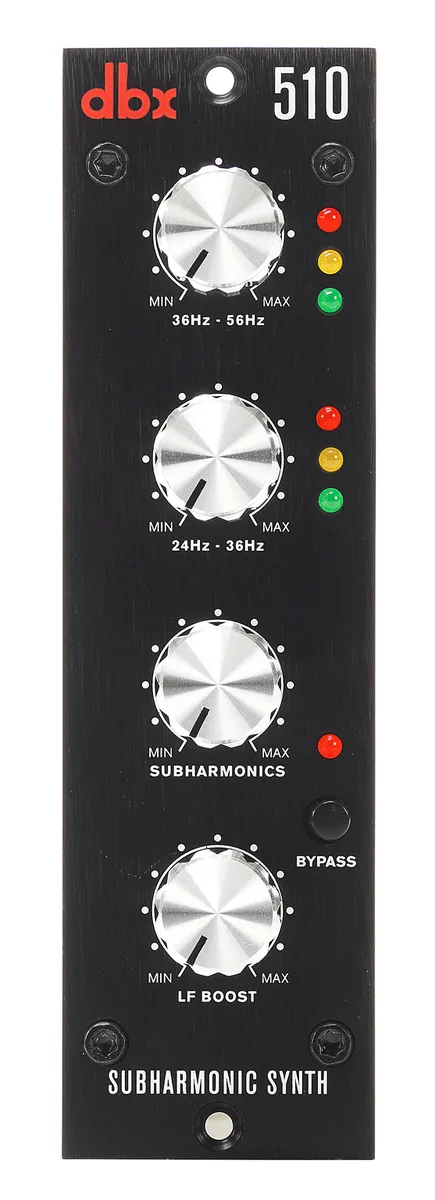 dbx 510 Subharmonic Synthesizer (500 Series)
View product ›
dbx 510 Subharmonic Synthesizer (500 Series)
View product ›
 dbx 520 De-Esser (500 Series)
View product ›
dbx 520 De-Esser (500 Series)
View product ›
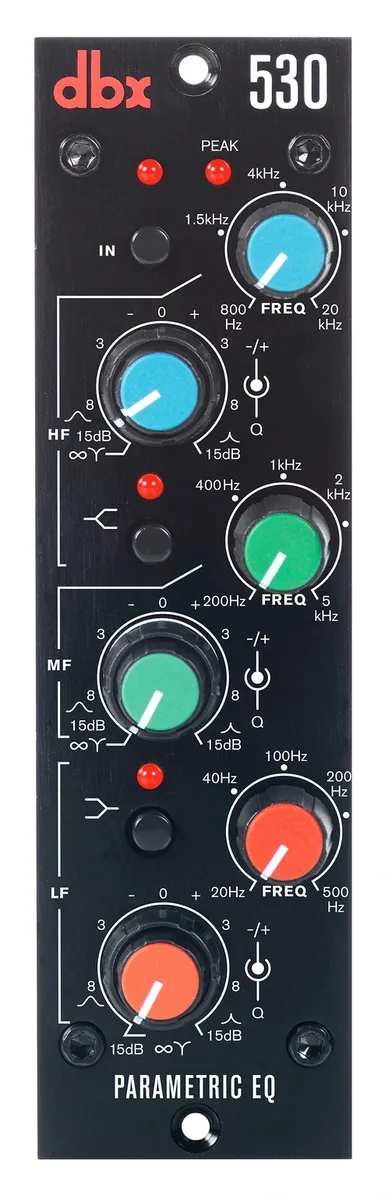 dbx 530 Parametric Equalizer (500 Series)
View product ›
dbx 530 Parametric Equalizer (500 Series)
View product ›
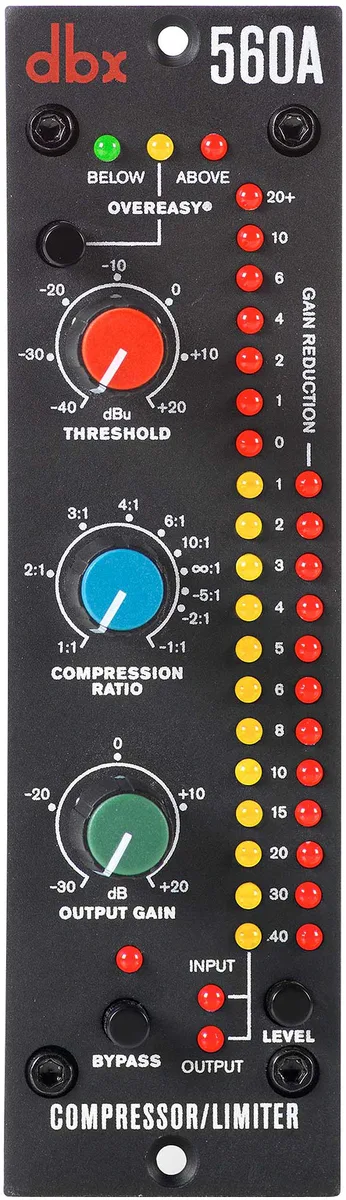 dbx 560A Compressor/Limiter (500 Series)
View product ›
dbx 560A Compressor/Limiter (500 Series)
View product ›
 dbx AFS2 Advanced Feedback Suppression Processor
View product ›
dbx AFS2 Advanced Feedback Suppression Processor
View product ›
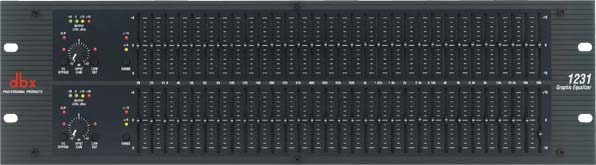 dbx Graphic Equalizer
View product ›
dbx Graphic Equalizer
View product ›