

Best HDMI Encoders: One Channel or Many, Rack or Portable
Short answer. One HDMI camera to YouTube, Facebook or an SRT decoder: the Magewell Ultra Encode HDMI. One HDMI or SDI source sent to as many as six destinations, with 1U rack ears in the box: the Magewell Ultra Encode AIO. A camera on the move with no wired internet: the Kiloview P3, which bonds four 5G or 4G modems with Wi-Fi and Ethernet. Several HDMI sources turned into channels for the TVs in a venue: the Contemporary Research QIP-HDMI 2 for two, the Kramer HDb2840i for four, the Kramer HDb2880i for eight. Twelve channels of audio from one HDMI source onto Dante: the TurtleAV Downtown.
The 7 Picks
Specs
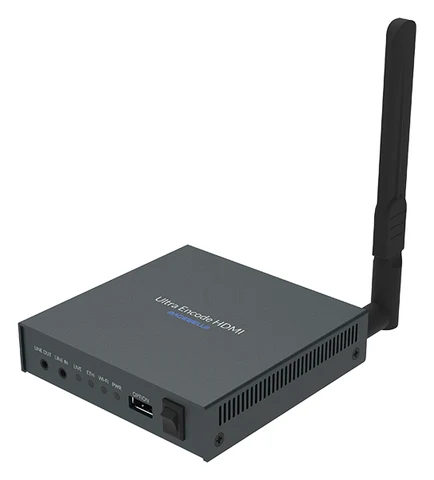
- Input
- HDMI with loop-through
- Max input
- 4096x2160 60fps (4:2:0)
- Channels
- 1
- Protocols
- RTSP, RTMP, RTMPS, SRT, NDI HX2, HLS, TS over UDP and RTP
- Mounting
- T-bracket included
- Use it for
- One HDMI camera or computer going live to YouTube, Facebook or Twitch, or over SRT to a decoder, with the picture looped through to a local monitor.
Specs
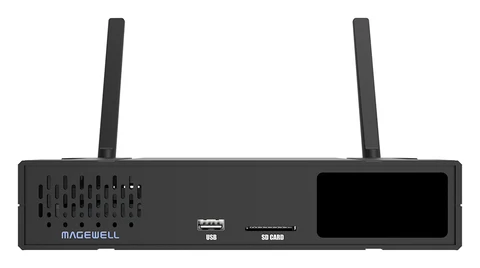
- Input
- HDMI and SDI
- Max input
- HDMI 4096x2160 60fps, SDI 4096x2160 30fps
- Channels
- 1, or HDMI and SDI mixed in one picture
- Protocols
- RTSP, RTMP, RTMPS, SRT, NDI HX2 and HX3, HLS, TS over UDP and RTP, TVU ISSP, ZIXI, RIST
- Mounting
- 1U rack ears included
- Use it for
- One source sent to up to six destinations at once, with recording to SD card or USB and schedules for each destination, in a rack.
Specs
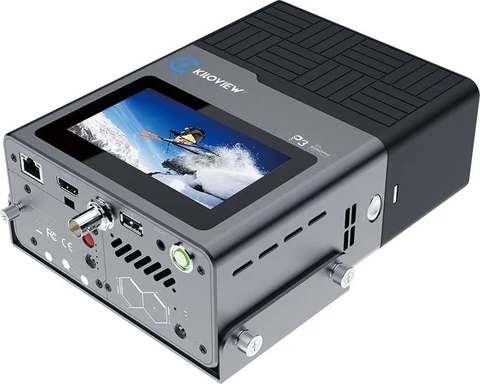
- Input
- HDMI 1.4b, 3G-SDI, USB
- Max input
- HDMI 4K30, SDI 1080p60
- Channels
- Up to 4 platform streams
- Protocols
- NDI HX2, SRT, RTMP, RTMPS, HLS, WHIP, TS over UDP, RTSP
- Mounting
- Backpack, battery 5 hours or more
- Use it for
- Streaming from a location with no wired internet, because it bonds four cellular modems with Wi-Fi and Ethernet.
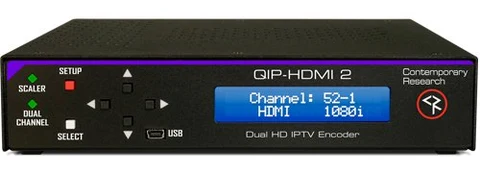
Specs
- Input
- 2 HDMI (non-HDCP)
- Max input
- 1080p
- Channels
- 2 IPTV streams
- Protocols
- Multicast or unicast IPTV, MPEG-2 or H.264
- Mounting
- 1RU, two side by side
- Use it for
- Two HDMI sources sent as IPTV channels to players and TVs on the network, where neither source outputs HDCP.
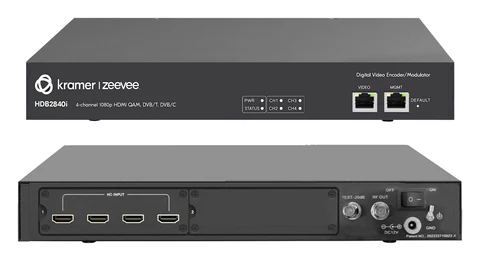
Specs
- Input
- 4 HDMI
- Max input
- 1080p
- Channels
- 4
- Protocols
- QAM 64/256, DVB-T, DVB-C on RF; UDP on IP; MPEG-2 or H.264
- Mounting
- 1RU, rack ears attached
- Use it for
- Four HDMI sources on every TV in a building, over the existing coax as QAM channels or over the network as UDP streams.
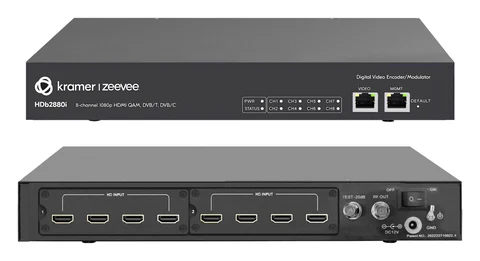
Specs
- Input
- 8 HDMI
- Max input
- 1080p60
- Channels
- 8
- Protocols
- QAM, DVB-T, DVB-C on RF; UDP on IP; MPEG-2 or H.264
- Mounting
- 1RU, rack ears attached, power supply included
- Use it for
- Eight HDMI sources put on the TVs across a venue, over coax or the network, from one rack unit.
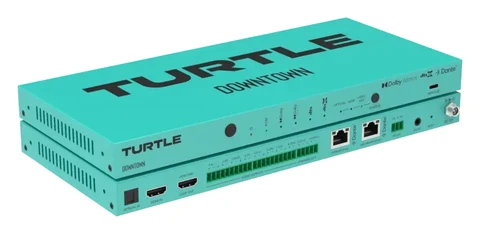
Specs
- Input
- HDMI 2.1 with loop out
- Channels
- 12 decoded audio channels on Dante
- Protocols
- Dante, PoE+ powered ports
- Mounting
- Metal desktop enclosure, 285 x 130 x 23 mm
- Use it for
- Taking the audio from one HDMI source onto a Dante network as 12 decoded channels while the video loops out.
Browse the Shelf
What Matters
A channel is one encoded source. The Magewell Ultra Encode AIO encodes one live source at a time, either its HDMI or its SDI input, or the two mixed as picture-in-picture or side by side. The multi-channel models here build TV channels, not platform streams: the Contemporary Research QIP-HDMI 2 makes two IPTV streams from two HDMI inputs, the Kramer HDb2840i takes four HDMI inputs and the HDb2880i takes eight. To send four cameras to a streaming platform, use one single-channel encoder per camera, or switch the cameras first and encode the program output.
No video encoder on our shelf takes twelve HDMI inputs in one chassis. The largest is the Kramer HDb2880i with eight. An HDb2880i and an HDb2840i together give twelve HDMI inputs in two rack units, since each is 1RU high, and both put out QAM, DVB-T and DVB-C channels plus UDP streams. If the twelve channels you need are audio, the TurtleAV Downtown takes one HDMI 2.1 source and puts 12 channels of decoded audio on a Dante network.
Pick the protocol from the destination. RTMP and RTMPS feed YouTube, Facebook and Twitch, which Magewell lists as native destinations. SRT is an open-source transport for low-latency streaming over the internet, to a decoder or a remote site. NDI is a video connectivity standard over IP, and its HX formats carry H.264 or HEVC. HLS sends live video to Apple devices and PCs from ordinary web servers. The Ultra Encode HDMI sends RTSP, RTMP, RTMPS, SRT, NDI HX2, HLS and TS over UDP or RTP. The Ultra Encode AIO adds NDI HX3, RIST, ZIXI and TVU ISSP. The Kiloview P3 sends NDI HX2, SRT, RTMP, RTMPS, HLS, WHIP, TS over UDP and RTSP. The Kramer HDb encoders stream UDP and the QIP-HDMI 2 sends multicast or unicast IPTV; none of the three lists RTMP or SRT.
For a system that runs all day in a bar, lobby or venue, look at how it mounts, how it is powered and whether it runs without someone at it. The Kramer HDb2840i and HDb2880i are 1RU with rack ears attached and the power supply in the box. The QIP-HDMI 2 is 1RU and 8.5 inches wide, so two mount side by side. The Ultra Encode AIO ships with 1U rack ears and runs recording and streaming on a schedule for each destination. None of these four product pages gives a 24/7 duty rating, so ask the maker for one in writing if your contract needs it.
A rack unit lives in a control room or headend with fixed power and network. A portable encoder brings its own connection. The Kiloview P3 bonds four 5G or 4G cellular modules, Wi-Fi and Ethernet into one link, runs at least five hours on its batteries, comes with a backpack and works from -15 to 45 C. The Ultra Encode HDMI ships with a T-bracket.
The Ultra Encode HDMI takes up to 4096x2160 at 60 fps (4:2:0) and loops the signal through. The Ultra Encode AIO takes 4096x2160 at 60 fps on HDMI and 30 fps on SDI. The Kiloview P3 takes 4K at 30 fps on HDMI and 1080p60 on SDI. The TV-channel encoders, the QIP-HDMI 2 and both Kramer HDb models, stop at 1080p.
The two Magewell encoders are the entry tier. The Kiloview P3, the two-channel QIP-HDMI 2 and the TurtleAV Downtown sit in the middle. The four- and eight-input Kramer HDb encoders are the top tier.
Questions
For feeds on the TVs around a venue, an encoder that builds TV channels. The Kramer HDb2880i takes eight HDMI sources and puts them out as QAM, DVB-T or DVB-C channels on the coax and as UDP streams on the network, from one rack unit. To stream the event to a platform as well, add a single-channel encoder such as the Magewell Ultra Encode AIO, which sends to six destinations at once.
For one source going to several places, the Magewell Ultra Encode AIO: HDMI and SDI inputs, H.264 or HEVC, SRT, RTMP, NDI HX and RIST, six sessions at once, recording to SD card or USB, and 1U rack ears in the box. For field work without wired internet, the Kiloview P3.
For a bar, lobby or venue that shows the same sources all day, a rack-mount TV-channel encoder: the Contemporary Research QIP-HDMI 2 for two HDMI sources, the Kramer HDb2840i for four, the HDb2880i for eight. The QIP-HDMI 2 takes non-HDCP HDMI only, so check that your sources do not output HDCP.
Not as one video encoder on our shelf. The largest is the eight-input Kramer HDb2880i, and an HDb2880i with a four-input HDb2840i gives twelve HDMI inputs in two rack units. For twelve audio channels from one HDMI source, the TurtleAV Downtown puts 12 channels of decoded audio on a Dante network.
Choose by how many sources you have and where they go. Two HDMI sources to IPTV players: the Contemporary Research QIP-HDMI 2. Four or eight to coax TVs and the network: the Kramer HDb2840i or HDb2880i. All three stop at 1080p.
For one HDMI camera going to YouTube, Facebook or Twitch, the Magewell Ultra Encode HDMI. It takes up to 4096x2160 at 60 fps and sends RTMP, RTMPS, SRT, HLS and NDI HX2. To send the same source to as many as six places at once, step up to the Ultra Encode AIO.
Questions? Talk to a Person.
Call (201) 791-1400 or email [email protected] - we've handled pro audio & video since 1988.