


Partyline or Wireless Intercom: Which Fits Your Crew
A partyline puts every station on one shared cable, so anyone plugged in hears the whole line. A wireless intercom swaps the cable for a radio link between a base and headsets or beltpacks. Fixed positions suit a partyline. Crew who walk the floor, the stage or the field suit wireless. Many productions run both, and some wireless bases connect straight into a partyline.
The 6 Picks
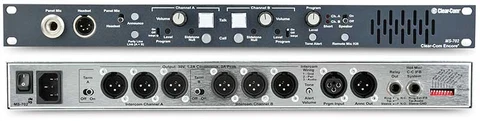
Specs
- Connection
- Wired partyline
- Channels
- 2
- Use it for
- The center of a two-channel Clear-Com Encore partyline in 1RU. It powers up to 55 beltpacks or 10 speaker stations. Powering the beltpacks from the main station means no separate supplies.
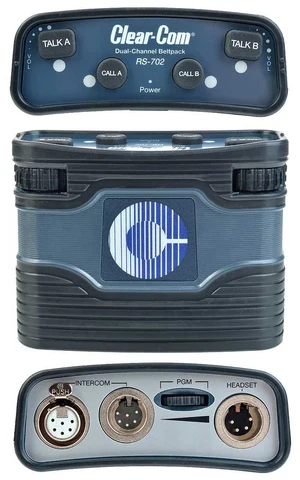
Specs
- Connection
- Wired partyline
- Channels
- 2
- Notable
- Connector: XLR-6 line connector
- Use it for
- A two-channel beltpack for the same partyline. It draws low operating current so more beltpacks can be daisy-chained, which matters because the main station powers the whole chain.
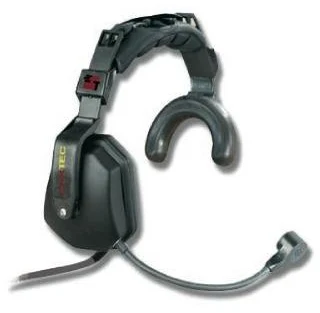
Specs
- Connection
- Wireless, no base station
- Notable
- Users: 4; Range: Up to 300 yards line of sight
- Use it for
- A small crew that needs full-duplex talk without running cable or buying a base. Eartec lists 5 to 6 hours per charge.
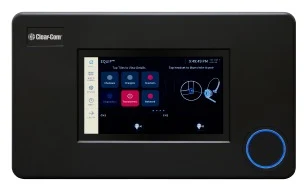
Specs
- Connection
- Wireless 5 GHz
- Channels
- 2
- Notable
- Users: 3 or 5 in the bundle
- Use it for
- A complete two-channel 5 GHz system for a school, house of worship or small production. The EQUIP base supports up to 40 headsets and 10 simultaneous talkers. A base station takes many more headsets than a set with none.
Specs
- Connection
- Wireless 2.4 GHz
- Channels
- 2
- Notable
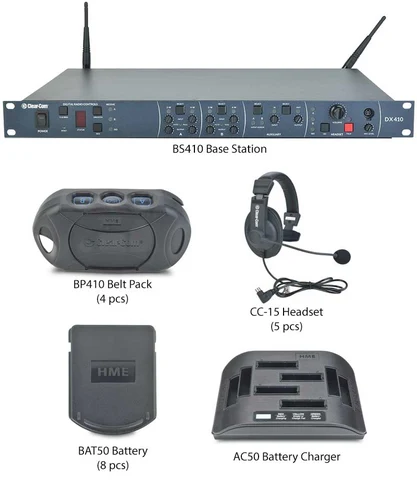
- Partyline: 2-wire and 4-wire; Beltpacks: (4) BP410 wireless beltpacks
- Use it for
- A wireless package that ties into an existing partyline. One DX410 base registers up to 15 beltpacks or headsets. On one channel four can talk full duplex at the same time; with both channels in use, three can. That lets fixed positions stay on the cable while the rest go wireless.
Specs
- Connection
- Wireless 1.9 and 2.4 GHz
- Channels
- Up to 12 channels/groups
- Notable
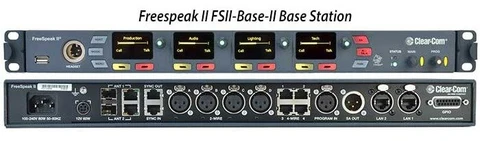
- Partyline: 2-wire; Beltpacks: 5 (10 and 25 versions exist)
- Use it for
- Roaming coverage across a larger building. The base takes up to 10 transceivers and integrates with 2-wire partyline. Ten transceivers spread the coverage across a bigger space.
Browse the Shelf
What Matters
Clear-Com describes its analog partyline as a 2-wire system where the talk and listen path is the same, so every station on a channel hears the others and can join in. Stations connect with two-conductor shielded microphone cable and 3-pin XLR connectors, and the main station sends DC power down the same cable. Because the line is shared, one cable run serves every station.
No cable to a position, so camera operators, stage managers and floor crew can move. A wireless system adds radio range, battery charging and channel planning to the job, and capacity depends on the system.
The Clear-Com DX410 base station has 2-wire connections for Clear-Com or RTS partyline systems, and the FreeSpeak II base station integrates with 2-wire analog partyline. Fixed positions stay on the cable while moving crew go wireless.
The Eartec UltraLITE-HD runs without a base station: one main headset relays to up to four remote headsets. The four-headset kit listed here is one main plus three remotes. With no base to set up, a small crew is talking as soon as the headsets are on.
Questions
A partyline connects every station on one shared cable, so all of them hear each other. A wireless intercom connects headsets or beltpacks to a base station by radio, so crew can move without a cable. Choose by whether people stay at positions or move.
Yes on some systems. The Clear-Com DX410 base station has 2-wire connections that work with Clear-Com or RTS partyline, and the FreeSpeak II base station integrates with 2-wire analog partyline. Fixed positions stay on the cable while moving crew go wireless.
Not always. Eartec UltraLITE-HD systems for 2 to 5 users run without one. Systems such as Clear-Com EQUIP, DX410 and FreeSpeak II use a base station. A set with no base suits a small crew, while a base station handles more headsets.
Questions? Talk to a Person.
Call (201) 791-1400 or email [email protected] - we've handled pro audio & video since 1988.