


Wireless Microphones for Church: Matching a System to Your Room
Church tech teams keep asking two things: why wireless mics drop out, and how to buy without overspending. Most dropouts come from the frequency plan, not the microphone, so the systems below are compared on how many channels they run together, how they find a clean frequency and how long a battery lasts. Four are handheld systems and one is a bodypack with a lavalier for hands-free speaking. This page covers entry and mid-range; it has no multi-channel systems for large campuses.
The 4 Picks
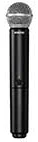
Specs
- Channels
- Dual receiver, two handhelds
- Battery
- Up to 14 hours on AA
- Notable
- Per band: Up to 12 channels
- Use it for
- Two handheld mics on one receiver for a small room, with one-touch scan to pick a frequency, because one receiver serves both mics and the scan finds a free channel.
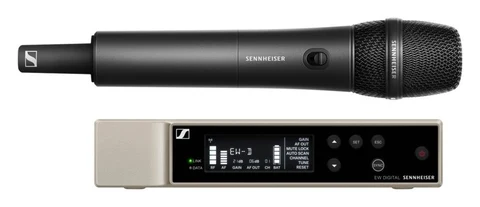
Specs
- Channels
- Up to 90
- Battery
- Up to 8 hours on AA
- Audio
- Digital UHF
- Use it for
- A larger channel count for a room that will add mics over time, with the e 835 capsule, since up to 90 channels leaves room to grow.
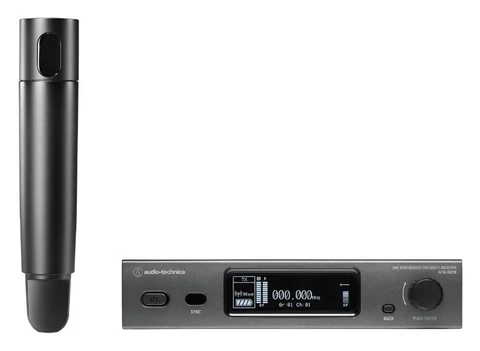
Specs
- Notable
- Tuning range: 60 MHz; Capsule: ATW-C510 dynamic
- Use it for
- A UHF handheld with a set backup frequency and a display on both receiver and transmitter, so interference mid-service can be fixed by swapping to the backup from the transmitter.
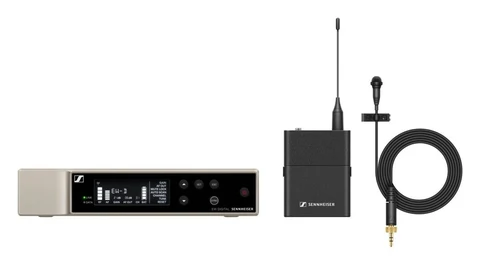
Specs
- Battery
- Up to 8 hours on AA
- Audio
- Digital UHF
- Notable
- Microphone: ME 2 omnidirectional lavalier
- Use it for
- A pastor or speaker who needs both hands free, with a bodypack transmitter and a clip-on mic, because the mic stays at the mouth without being held.
Browse the Shelf
What Matters
Count every wireless mic that will be on at once: pulpit, worship leader, choir and a lavalier or two. The Shure BLX runs up to 12 channels per frequency band. The Sennheiser EW-D lists up to 90 channels across 2,240 selectable frequencies. Each mic needs its own channel, so the count sets which system you can use.
Dropouts usually mean another signal is on your frequency. The Shure BLX has one-touch scan and selection. The Audio-Technica 3000 Series lets you set a backup frequency and swap to it from the transmitter when interference appears. A clean frequency is one nothing else is using.
Shure lists up to 14 hours from a pair of AA batteries in a BLX transmitter. Sennheiser lists up to 8 hours on the two AA batteries in the EW-D handheld and up to 12 hours with its lithium-ion pack, which is sold separately. Match runtime to your longest service.
Shure lists the BLX at up to 300 feet in open conditions with no interfering signals. A sanctuary with a balcony, pillars or a full congregation will see less. Check which TV-band frequencies are available in your region before you buy, since they differ by country and by area.
The system sets here use known capsules: SM58 on the Shure systems and the Sennheiser e 835 capsule on the EW-D. The Audio-Technica system listed uses the ATW-C510 cardioid dynamic capsule. For hands-free speaking, the Sennheiser EW-D ME2 set pairs a bodypack with the ME 2, an omnidirectional clip-on microphone. Pick the capsule by how the speaker holds the mic: in hand for a handheld, on the lapel for hands-free.
Questions
Another signal on the same frequency is the usual cause. Pick a system that lets you scan for a clean frequency or keep a backup frequency ready, such as the Shure BLX one-touch scan or the Audio-Technica 3000 Series backup frequency, because either lets you move off a busy frequency.
It depends on the system and the band. Shure lists up to 12 channels per frequency band on the BLX, and Sennheiser lists up to 90 channels on the EW-D. Count the mics you will have on at once, since each needs its own channel without clashing.
Questions? Talk to a Person.
Call (201) 791-1400 or email [email protected] - we've handled pro audio & video since 1988.