


Shure ULX-D vs Axient Digital: ULXD4D and AD4D Compared
The ULXD4D and AD4D are both two-channel, one-rack-unit digital receivers with AES-256 encryption, Dante audio over Ethernet, a High Density mode for crowded spectrum and an RF cascade to one more receiver. The AD4D adds a wider tuning range per band, lower latency in standard mode, AES3 and AES67 digital outputs, a quarter-inch output per channel and frequency diversity from a single handheld. The two lines use different transmitters: ULX-D receivers pair with ULXD1, ULXD2, ULXD6 and ULXD8 transmitters, and the AD4D with AD and ADX series transmitters.
Side by Side
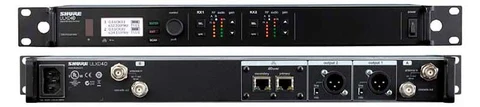
Specs
- Channels
- 2
- RF carrier range (system)
- 470-932 MHz, varies by region
- Tuning range per band
- Up to 166 MHz, region dependent
- Working range
- 100 m (330 ft)
- Latency
- Under 2.9 ms
- Encryption
- AES-256
- Diversity
- Digital predictive switching diversity
- Frequency diversity
- Bodypack: two transmitters from one source on two channels
- High Density mode
- Yes, 1 mW, up to 30 m range
- Analog outputs
- One balanced XLR per channel, mic/line switch
- Digital outputs
- Dante over two Ethernet ports
- Compatible transmitters
- ULXD1, ULXD2, ULXD6, ULXD8
- Rack size and dimensions
- 1RU, 44 x 482 x 274 mm (H x W x D)
- Weight
- 3.36 kg (7.4 lb) without antennas
- Power
- Internal supply, 100-240 V AC
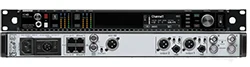
Specs
- Channels
- 2
- RF carrier range (system)
- 470-960 MHz, varies by region
- Tuning range per band
- Up to 184 MHz
- Working range
- 100 m (330 ft)
- Latency
- 2.08 ms standard mode, 2.96 ms High Density mode (analog output)
- Encryption
- AES-256
- Diversity
- True digital diversity per channel
- Frequency diversity
- Selection with a pair of AD1 or ADX1 bodypacks, combining with one ADX2FD handheld
- High Density mode
- Yes, 2 mW, up to 47 transmitters in one 6 MHz TV channel
- Analog outputs
- Two transformer-balanced XLR and two 1/4-inch TRS
- Digital outputs
- Dante or AES67 over Ethernet, plus AES3
- Compatible transmitters
- All AD and ADX series transmitters
- Rack size and dimensions
- 1RU, 44 x 483 x 333 mm (H x W x D)
- Weight
- 4.6 kg (10.1 lb) without antennas
- Power
- 100-240 V AC, locking connector, optional DC module
What Matters
Two encrypted channels on Dante with an XLR per channel, audio summing, and transmitters that include the ULXD6 boundary and ULXD8 gooseneck mics.
Systems that need AES3 or AES67 output, 2.08 ms latency, frequency diversity from one ADX2FD handheld, ShowLink control of ADX transmitters, or the wider tuning range per band.
Match the receiver to the line you have. The AD4D works with AD and ADX transmitters, and ULX-D receivers with ULX-D transmitters. Shure's ANX4 receiver runs either line, one at a time.
Both lines also come as quad receivers, the ULXD4Q and AD4Q.
Questions
Comparing the two-channel receivers, the AD4D tunes up to 184 MHz per band against 166 MHz for the ULXD4D, runs 2.08 ms latency in standard mode against under 2.9 ms, and adds AES3 and AES67 outputs, quarter-inch outputs, frequency diversity from one ADX2FD handheld and ShowLink control of ADX transmitters. Both have AES-256 encryption, Dante and a High Density mode.
Shure lists the AD4D as compatible with AD and ADX series transmitters, and pairs ULX-D receivers with ULXD1, ULXD2, ULXD6 and ULXD8 transmitters. The Shure receiver that runs both is the ANX4, which works with Axient Digital or ULX-D transmitters, one system at a time.
Questions? Talk to a Person.
Call (201) 791-1400 or email [email protected] - we've handled pro audio & video since 1988.