


Best PTZ Cameras for Church: Matching Zoom and Outputs to Your Sanctuary
A church camera usually mounts on the back wall or a balcony rail, a long way from the pulpit, and it has to move during the sermon without the congregation hearing it. The six cameras below are compared on the numbers that decide that: how tight the shot gets at a distance, what each one sends to your switcher or encoder, how much light it needs and whether the maker publishes a noise rating. One is an entry pick, three are mid-range and two are for large rooms with long throws. Streaming encoders are covered in a separate guide.
The 6 Picks
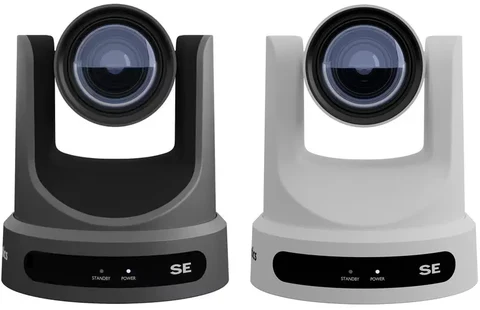
Specs
- Optical zoom
- 30x
- Tele angle (width at 100 ft)
- 2.3 degrees (about 4 ft)
- Top resolution
- 1080p60
- Outputs
- HDMI, 3G-SDI, USB 3.0, IP with NDI|HX
- Sensor
- 1/2.8-inch CMOS
- Minimum light (maker test)
- 0.5 lux at F1.8, gain on
- Presets
- 255
- Network power
- PoE (802.3af)
- Use it for
- A first camera, or the back-wall camera in a small to mid-size room. It has the tightest tele angle here and all four outputs, so it plugs into the switcher or computer you already have. It stops at 1080p.
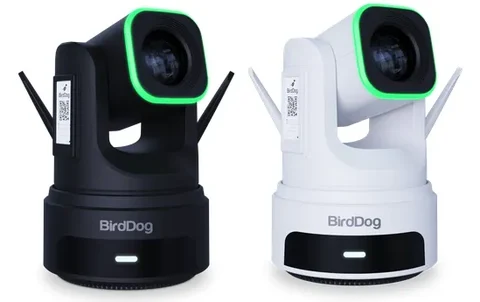
Specs
- Optical zoom
- 20x
- Tele angle (width at 100 ft)
- 3.5 degrees (about 6 ft)
- Top resolution
- 2160p60
- Outputs
- HDMI, 3G-SDI, USB-C, IP with NDI|HX3 and SRT
- Sensor
- 1/1.8-inch CMOS
- Minimum light (maker test)
- 0.5 lux
- Presets
- 255
- Network power
- PoE+ (802.3at)
- Use it for
- A 4K camera with all four outputs for a medium throw. At 20x it frames wider than the 30x cameras from the same spot, so it suits a side wall or the middle of the room better than the back of a long one.
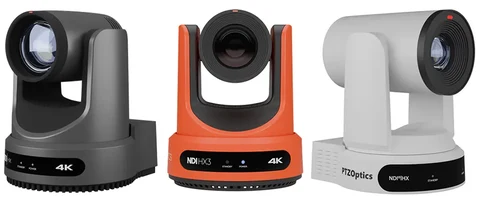
Specs
- Optical zoom
- 30x
- Tele angle (width at 100 ft)
- 2.5 degrees (about 4.4 ft)
- Top resolution
- 2160p60
- Outputs
- HDMI 2.0, 3G-SDI, IP with NDI|HX3
- Sensor
- 1/1.8-inch CMOS
- Minimum light (maker test)
- 0.5 lux at F1.8, gain on
- Presets
- 255
- Network power
- PoE+ (802.3at)
- Use it for
- The longest 4K reach on this page, for a back-wall camera in a long room. Use it where the shot has to get tight from far away and the system runs on NDI or SDI.
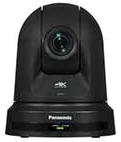
Specs
- Optical zoom
- 24x
- Tele angle (width at 100 ft)
- 3.3 degrees (about 5.8 ft)
- Top resolution
- 2160p30
- Outputs
- HDMI, 3G-SDI, USB-C, IP with SRT (NDI|HX as a paid upgrade)
- Minimum light (maker test)
- 3 lx at F1.8, 42 dB
- Pan/tilt noise
- NC25 or less
- Network power
- PoE+ (802.3at)
- Use it for
- A camera close to the pulpit or choir, where motor noise would reach a microphone. It has a published NC25 rating and USB for a computer-based stream. Its 4K stops at 30p, and NDI costs extra.
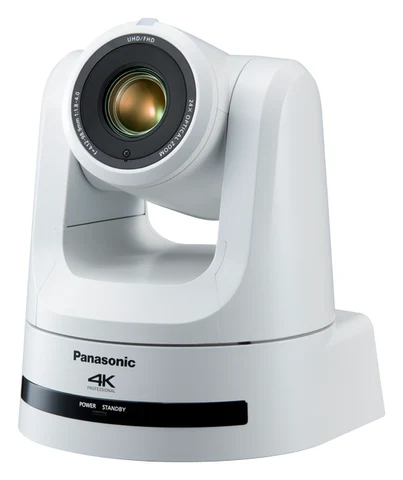
Specs
- Optical zoom
- 24x
- Tele angle (width at 100 ft)
- 3.3 degrees (about 5.8 ft)
- Top resolution
- 2160p60
- Outputs
- 12G-SDI, 3G-SDI, HDMI 2.0, IP with full NDI, NDI|HX2 and SRT
- Sensor
- 1/2.5-type MOS
- Minimum light (maker test)
- 3 lx at F1.8, 42 dB
- Pan/tilt noise
- NC25 or less
- Presets
- Up to 100 (depends on controller)
- Network power
- PoE++ (802.3bt)
- Use it for
- A large room built on an NDI network or an SDI backbone. Full NDI and 12G-SDI come standard, and it pairs 24x zoom with the same NC25 rating as the AW-UE50.
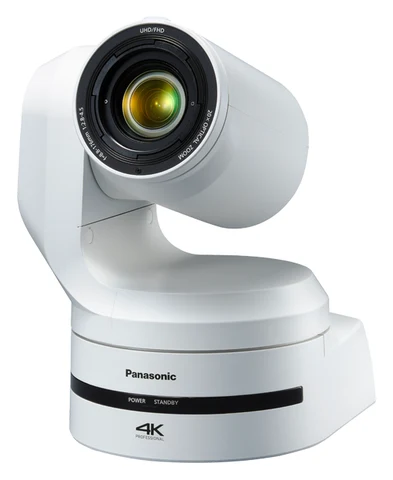
Specs
- Optical zoom
- 20x
- Tele angle (width at 100 ft)
- 4.0 degrees (about 7 ft)
- Top resolution
- 2160p60
- Outputs
- 12G-SDI, two 3G-SDI, HDMI 2.0, SFP+ fiber, IP with full NDI, NDI|HX2 and SRT
- Sensor
- 1-type MOS
- Minimum light (maker test)
- 2 lx at F2.8, 42 dB
- Pan/tilt noise
- NC35 or less (up to 60 degrees/s)
- Network power
- PoE++ (802.3bt)
- Use it for
- A dim room where picture quality comes first. It has the largest sensor here and the most outputs, including fiber for a long run. Its 4.0-degree tele angle is the widest here, so mount it closer or plan on a looser shot.
Browse the Shelf
What Matters
Measure from where the camera will mount to the pulpit. The zoom ratio alone does not tell you the shot; the narrowest horizontal angle does. Each degree of angle covers about 1.75 feet of width for every 100 feet of distance. At 100 feet the Move SE 30X, at 2.3 degrees, frames a strip about 4 feet wide, roughly head and shoulders. The AW-UE150A, at 4.0 degrees, frames about 7 feet, closer to waist up. Digital zoom crops the picture and is left out of these numbers.
A room lit for the congregation rather than for cameras asks more of the sensor than a studio does. The AW-UE150A has a 1-type sensor, and Panasonic lists it at 2 lx at F2.8, against 3 lx at F1.8 for the AW-UE50 and AW-UE100. Makers test minimum light under different conditions: PTZOptics with gain on, Panasonic at 50 IRE and 42 dB of gain. Compare these figures within one brand, not across brands.
Match the camera to what it plugs into. SDI suits long cable runs to a hardware switcher, HDMI suits short runs, USB goes straight into a computer as a webcam, and NDI carries video and camera control over the network. The AW-UE100 and AW-UE150A send full-bandwidth NDI as standard and add 12G-SDI. The Move 4K and the BirdDog X4 Ultra send NDI|HX3, the low-bandwidth form. On the AW-UE50, NDI|HX is a paid upgrade; out of the box it streams SRT.
Store one preset for each shot you cut to every week: the pulpit, the choir, the baptistry and a wide of the room. PTZOptics and BirdDog list 255 presets. Panasonic's AW-UE100 manual lists up to 100, and how many you can reach depends on the controller. On the PTZOptics IR remote, presets 0 to 9 recall with one number button; the web interface and PTZ controllers reach the rest.
Panasonic publishes a noise rating: NC25 or less for the AW-UE50 and AW-UE100, and NC35 or less for the AW-UE150A at up to 60 degrees per second. Panasonic also warns that its two faster pan/tilt modes can be loud and says to use Normal mode if the noise is disturbing. PTZOptics and BirdDog list no noise rating on their spec pages, so listen to one in your room before you mount it near the pulpit or choir microphones.
Every camera here can run on power from a network switch, but the class differs. The Move SE takes PoE (802.3af); the Move 4K, X4 Ultra and AW-UE50 take PoE+ (802.3at); the AW-UE100 and AW-UE150A need PoE++ (802.3bt). Check the switch port before you order.
Questions
A PTZ camera mounted at the back of the room and run from the booth with presets. Pick it by distance first: at 100 feet the Move SE 30X frames about 4 feet wide and the AW-UE150A about 7. Then match the output to your switcher or encoder, and choose a camera with a published noise rating if it sits near a microphone.
A camcorder needs a person beside it to pan and zoom. A PTZ camera is moved from the booth and recalls stored shots by number, and every camera on this page can take its power from a PoE network switch.
All six, in different forms. The Panasonic AW-UE100 and AW-UE150A send full-bandwidth NDI as standard. The PTZOptics Move 4K and BirdDog X4 Ultra send NDI|HX3, and the Move SE sends NDI|HX. On the AW-UE50, NDI|HX is a paid upgrade.
Questions? Talk to a Person.
Call (201) 791-1400 or email [email protected] - we've handled pro audio & video since 1988.